Common sage is an aromatic, bushy, semi-woody shrub native to the Mediterranean region [2]. It grows up to about 2 feet tall and needs full sun and well-drained soil [2], so it is easy to grow in many North American herb gardens. It is best known as a kitchen herb [1].
Sage is promoted for menopause symptoms, memory, and cholesterol [4]. A few small studies suggest it might help hot flashes, but the evidence is limited [4]. European regulators accept sage leaf as a traditional remedy for mild indigestion, excessive sweating, mouth and throat inflammation, and minor skin inflammation [3].
Sage contains thujone, a compound that is toxic to the nervous system in large amounts [3][4]. Food amounts are likely safe, but high doses, long-term use, and the essential oil carry real risks [4][5].
Watch the common names: the Salvia genus has about 900 species [1]. Fresh "sage" in supermarkets is often Greek sage (Salvia fruticosa) [2]. "Red sage" and "desert brush sage" are unrelated plants [1]. See Look-alikes to avoid.
Where the name comes from:Salvia comes from the Latin salvere, "to cure" [1]. Officinalis refers to its medicinal use and sale in herb shops and pharmacies [2].
❦
Traditional uses
This section describes how people have used sage historically. It does not show that these uses work. See the next section for the evidence.
Mouth and throat: tinctures and teas have been used for inflammation in the mouth and for sore throat and tonsillitis [1]. The EU's traditional-use monograph lists inflammation in the mouth or throat, used as a gargle or rinse [3].
Digestion: sage has been used for gut inflammation, diarrhea, and gastritis, and as a tonic [1]. The EU monograph lists mild indigestion such as heartburn and bloating [3].
Sweating: sage has long been used to reduce excessive sweating, including hot flashes [1][6]. The EU monograph includes excessive sweating [3].
Memory: the ancient Greeks used sage to improve memory [1].
Skin: used as an antiseptic and astringent [1]. The EU monograph lists minor skin inflammation [3].
Breastfeeding: sage has traditionally been used to reduce milk supply, for example when weaning [7].
Food and fragrance: the leaves are a culinary spice, and sage oil is used in soaps and perfumes [1].
❦
What the evidence says
Bottom line: a few small studies, nothing conclusive. Drugs.com says no quality clinical trials support sage's traditional uses [1]. European regulators approve sage only for traditional use [3].
Use
What was found
Strength
Menopausal hot flashes
NCCIH says a few small studies suggest sage might reduce how often hot flashes happen [4]. In one 8-week study of 71 women, a daily fresh-sage tablet was linked to fewer and milder hot flashes, but there was no placebo group [6].
Weak.
Memory and thinking
A few studies in healthy people found better scores on memory or thinking tests, but there is too little evidence to draw conclusions. It's uncertain whether sage helps people with Alzheimer's disease [4].
Weak and preliminary.
Cholesterol and blood sugar
A few studies suggest effects on cholesterol and other blood fats. There isn't enough evidence for blood sugar [4].
Weak.
Sore throat, indigestion, sweating
Accepted in Europe on the basis of long use, not clinical trials [3].
Traditional use only.
What we can't say: sage has not been shown to treat menopause symptoms, memory loss, Alzheimer's disease, or high cholesterol. Don't use it in place of medical care.
❦
How it’s used / prepared
This is general, traditional information, not a recommendation or a dose for you. Talk with a health professional before using sage for a health purpose.
As food: sage is likely safe in the amounts normally used in food [4]. The U.S. FDA lists sage as a "generally recognized as safe" spice [8]. NC State Extension says the edible flowers should not be eaten in large amounts [2].
Tea (infusion): the EU traditional-use monograph describes 1–2 g of dried sage leaf in 150 ml (about ⅔ cup) of boiling water, 3 times a day, for indigestion, for adults [3].
Gargle or mouth rinse: the monograph describes 2.5 g of leaf in 100 ml of boiling water, used warm as a gargle 3 times a day [3].
Tincture and extracts: also described in the monograph [3]. Tinctures contain alcohol [3].
Limit thujone: EU regulators say low-thujone types should be preferred, and medicinal products should keep daily thujone exposure below 6 mg [3]. Larger amounts of sage have been used safely in studies for up to 8 weeks [4].
Essential oil: not for swallowing or for use around children. Thujone and camphor in the oil are toxic to the nervous system in high doses [5][7].
When to stop and get help: in the EU guidance, see a doctor if symptoms last more than 2 weeks (indigestion or skin), 1 week (mouth or throat), or 6 weeks (sweating), or if they get worse [3].
❦
How to identify
Common sage is a garden and store herb, so you don't need to forage it.
Plant: a bushy, spreading, semi-woody, evergreen shrub up to about 2 feet tall and 2–3 feet wide [2].
Stems: square and green when young, becoming woody with age [2].
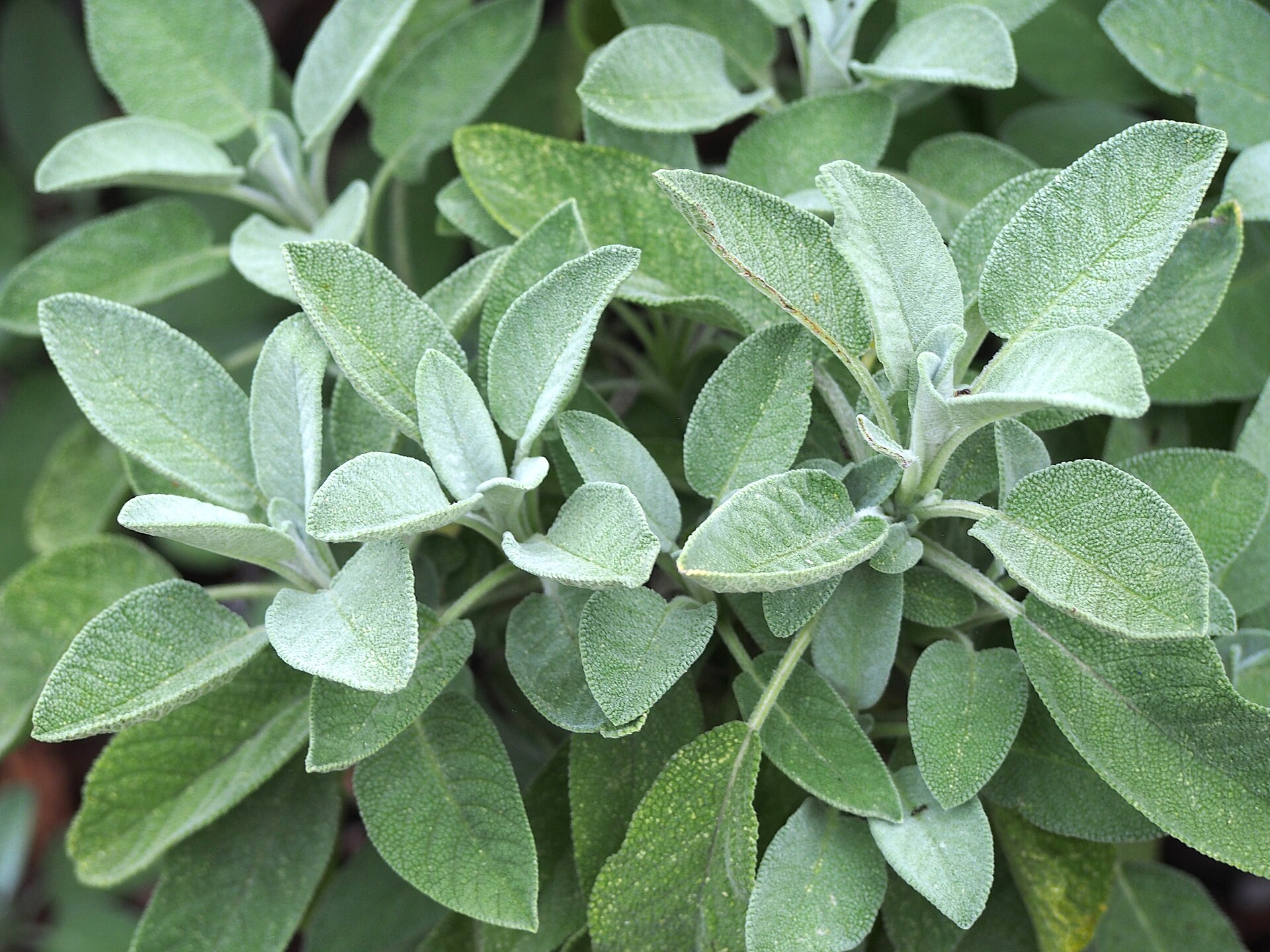
Leaves: grayish green, fuzzy, textured, oval, and in opposite pairs, with smooth edges. Common sage leaves are always simple (one blade) [2].
Flowers: two-lipped, bluish-lavender to pinkish-lavender flowers in whorls on upright spikes, in early summer [2].
We did not find a source describing a dangerous wild look-alike for common sage. The main issue is that many different plants are called "sage."
Greek sage (Salvia fruticosa)
How to tell: mature leaves are trifoliolate (three leaflets), while common sage leaves are always simple [2].
Why it matters: it is often what's sold as fresh sage in supermarkets [2]. It has also been used to reduce milk supply [7].
Other Salvia species
Why it matters: sage is often misidentified or adulterated. Salvia bertolonii or Salvia pratensis are sometimes used in place of common sage [7]. Ornamental sage cultivars may not taste as good for cooking [2].
"Red sage" and "desert brush sage"
Why it matters: these are unrelated plants that share the name [1]. Always check the botanical name.
❦
Safety and interactions
Thujone: some sage species, including common sage, contain thujone, which can be toxic in large amounts. Sage may be unsafe in high doses or when used for a long time [4]. Thujone and camphor are both toxic to the nervous system in high doses [7].
Seizures in children: a newborn and a toddler had generalized seizures after accidental exposure to sage oil [5]. The authors noted that sage oil contains seizure-causing compounds such as thujone, camphor, and cineole [5].
Side effects: sage is generally well tolerated, but nausea, vomiting, stomach pain, dizziness, agitation, and wheezing have been reported [7]. Lip or mouth irritation and dry mouth have been reported after eating sage [1].
Skin: one person developed an allergic skin reaction to a lip balm containing sage [1]. Don't use sage if you are allergic to it [3].
Pregnancy: sage may be unsafe during pregnancy because its thujone may have harmful effects [4]. EU regulators don't recommend sage medicines during pregnancy [3].
Breastfeeding: little is known about safety [4]. Sage is traditionally used to reduce milk supply, although no studies have tested this [7]. EU regulators don't recommend sage medicines while breastfeeding [3].
Children: the EU guidance does not recommend sage medicines for anyone under 18 because of a lack of data [3]. Keep the essential oil away from children [5].
Medication interactions: no well-documented interactions. Drugs.com says interactions with cholinergic drugs, such as pilocarpine and scopolamine, are expected based on sage's effects in lab and Alzheimer's studies [1]. The EU monograph reports none [3]. Ask your pharmacist if you take regular medication.
Blood pressure: blood pressure rose in 2 people with high blood pressure during a trial of Spanish sage oil [1].
Pets: the ASPCA lists sage as non-toxic to dogs, cats, and horses [10].
Not medical advice
This page is for general education only. It is not medical advice and doesn't replace a doctor, pharmacist, or other qualified professional. Herbs can cause allergic reactions and interact with medicines. Check with a health professional before using any herb, especially if you are pregnant or breastfeeding, giving it to a child, taking medication, or managing a health condition. Never eat or use a wild plant unless an expert has confirmed what it is. For a suspected poisoning in the U.S., call Poison Help at 1-800-222-1222 [9]. In Canada, call 1-844-POISON-X (1-844-764-7669), or the Centre antipoison du Québec at 1-800-463-5060 if you are in Québec [11].
National Center for Complementary and Integrative Health (NCCIH). Sage: Usefulness and Safety. Updated April 2025. https://www.nccih.nih.gov/health/sage
Halicioglu O, Astarcioglu G, Yaprak I, Aydinlioglu H. Toxicity of Salvia officinalis in a newborn and a child: an alarming report. Pediatr Neurol. 2011. https://pubmed.ncbi.nlm.nih.gov/21907890/
Bommer S, Klein P, Suter A. First time proof of sage's tolerability and efficacy in menopausal women with hot flushes. Adv Ther. 2011. https://pubmed.ncbi.nlm.nih.gov/21630133/
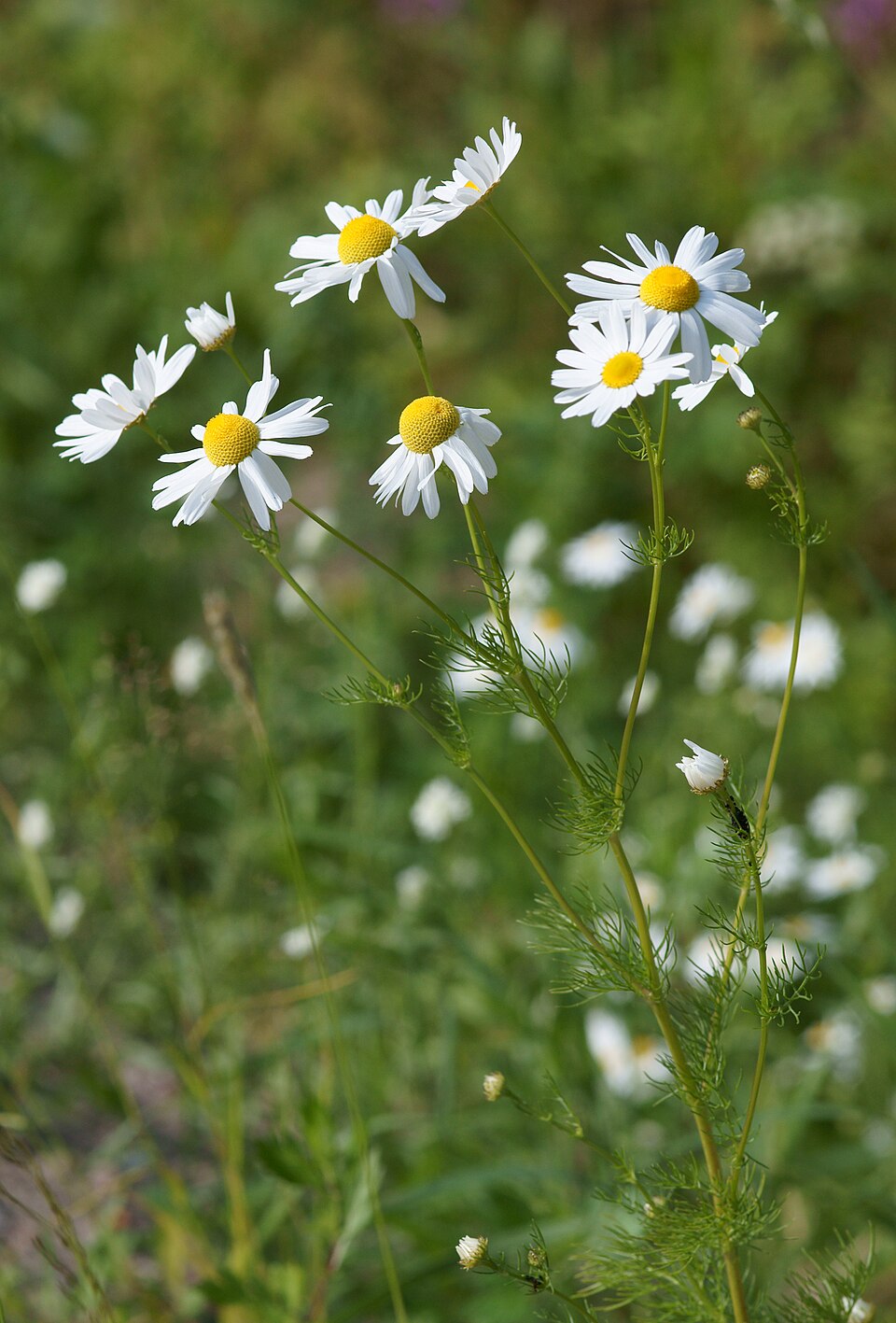
German chamomile is a small, sweet-smelling annual with feathery leaves and little daisy-like flowers that have white petals and a domed yellow center.