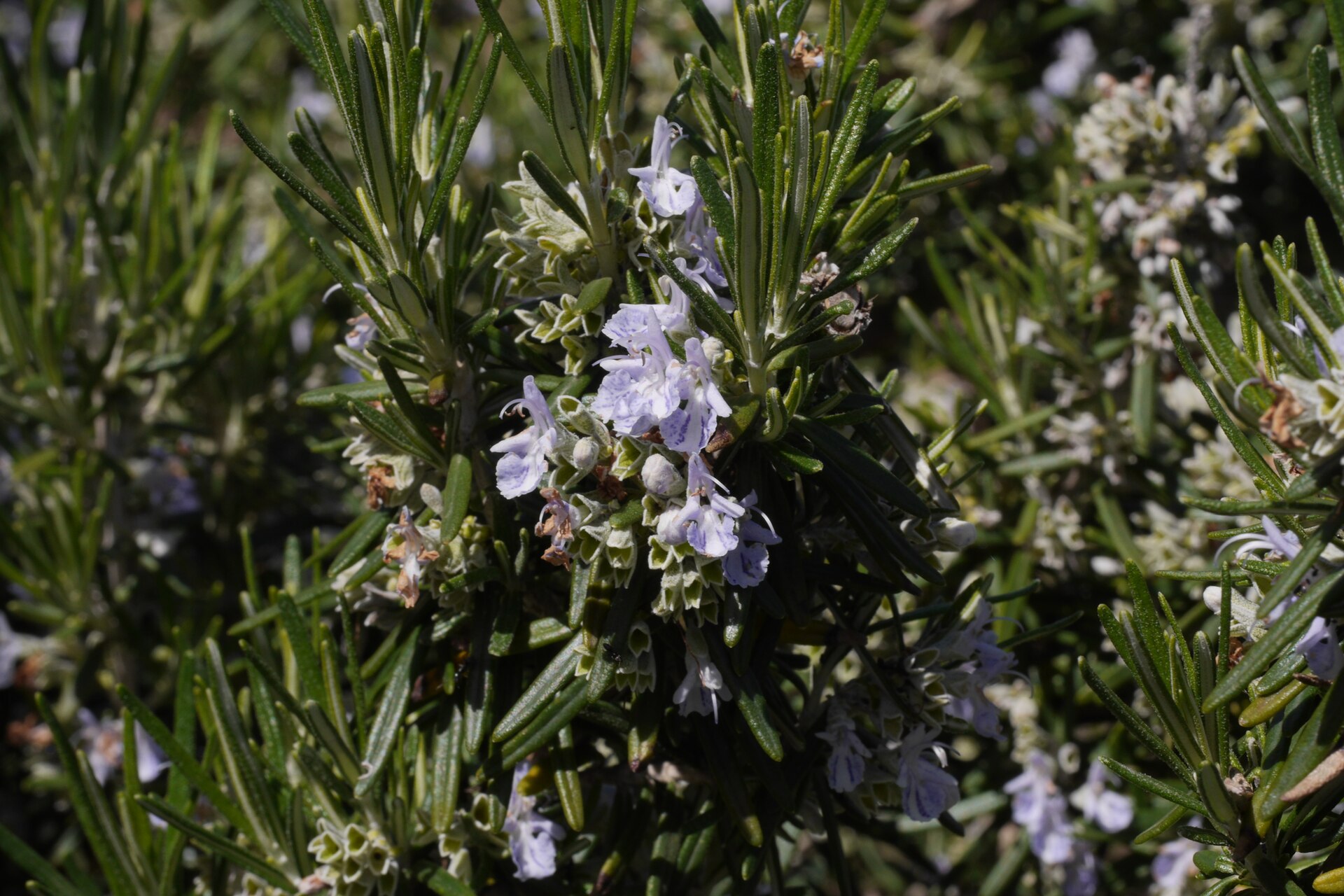
Rosemary is an aromatic, evergreen shrub in the mint family, native to the Mediterranean region, Africa, Europe, and western Asia, where it grows in dry, rocky areas [2]. It usually grows 4–5 feet tall and needs full sun and well-drained soil [2]. In North America it is a garden and kitchen herb, not a native wild plant.
Rosemary is mainly a culinary herb [1]. Drugs.com says there is too little clinical data to recommend it for any health use [1]. European regulators accept rosemary leaf as a traditional remedy for indigestion and, as a bath additive, for minor muscle and joint pain and minor circulation problems [3].
The leaf in food amounts has "generally recognized as safe" status in the U.S. [5]. The main concerns are the concentrated essential oil, which is high in camphor, and confusion with the poisonous bog rosemary[1][4].
Quick facts
Specimen · Lamiaceae
Botanical name
Salvia rosmarinus (formerly Rosmarinus officinalis L.)
Botanical name:Salvia rosmarinus. It was previously known as Rosmarinus officinalis L., and many sources, labels, and studies still use that name [1][2][3].
Watch the common names: "bog rosemary" (Andromeda polifolia) and "marsh rosemary" (Rhododendron tomentosum) are unrelated plants from the heath family [1]. Bog rosemary is poisonous [4]. See Look-alikes to avoid.
Where the name comes from:Salvia comes from the Latin for "to save or heal." Rosmarinus means "dew of the sea," probably because rosemary thrives on coasts and sea cliffs [2].
❦
Traditional uses
This section describes how people have used rosemary historically. It does not show that these uses work. See the next section for the evidence.
Digestion: rosemary has been used as a tonic, to relieve gas, and to ease cramping [1]. Germany's Commission E approved rosemary leaf for indigestion [1], and the EU's traditional-use monograph lists indigestion and mild gut spasms [3].
Muscles, joints, and circulation: Commission E approved rosemary leaf for external use in rheumatic conditions [1]. The EU monograph lists rosemary baths for minor muscle and joint pain and minor circulation problems [3].
Periods: extracts and the oil have been used to bring on menstrual periods and to cause abortion [1]. This is a safety concern, not a recommendation.
Hair: a rosemary lotion has been said to stimulate hair growth and prevent baldness [1].
Food and cosmetics: a widely used culinary spice, and a common ingredient in cosmetics [1].
❦
What the evidence says
Bottom line: limited clinical data; not enough to recommend rosemary for any health use [1]. NCCIH does not have a fact sheet on rosemary, so this summary relies on the Drugs.com professional monograph, the EU monograph, and individual studies.
Use
What was found
Strength
Memory in older adults
In a crossover study of 28 older adults, a low dose of dried rosemary leaf (750 mg, close to food amounts) improved memory speed, while a high dose (6 g) impaired it [6].
Very preliminary.
Memory and mood (smelling the oil)
At least 2 small trials found better recall with rosemary aromatherapy. More studies are needed [1].
Weak.
Hair loss (androgenetic alopecia)
In a 6-month trial of 100 people, rosemary oil and minoxidil 2% both increased hair counts by a similar amount, with less scalp itching in the rosemary group. There was no placebo group [7].
Weak (one trial).
Gum health
One trial of 110 volunteers found a rosemary toothpaste reduced gum bleeding and plaque compared with a regular toothpaste [1].
Very preliminary.
Indigestion, muscle and joint pain
Accepted in Europe on the basis of long use, not clinical trials [3].
Traditional use only.
What we can't say: rosemary has not been shown to prevent or treat memory loss, dementia, or baldness. Higher doses may even work against memory [6].
❦
How it’s used / prepared
This is general, traditional information, not a recommendation or a dose for you. Talk with a health professional before using rosemary for a health purpose.
Parts used: the leaves, and the essential oil distilled from the plant [1][3].
As food: rosemary has "generally recognized as safe" status as a spice in the U.S. [5]. Food amounts are not a concern for most people [1].
Tea (infusion): the EU traditional-use monograph describes 1–2 g of dried leaf in 150–250 ml of boiling water, 2–3 times a day (2–6 g a day), for people 12 and older [3].
Bath: the monograph describes 50 g of leaf, either brewed in 1 liter of boiling water or added directly to the bath, 2–3 times a week, at 35–38 °C (95–100 °F) for 10–20 minutes [3]. Don't use it on broken or irritated skin, and use full hot baths with caution if you have high blood pressure [3].
Aromatherapy: studies of rosemary oil used 3–4 drops for inhalation [1].
Essential oil: don't swallow it. Ingesting large amounts can be toxic [1]. Rosemary oil contains 20–50% camphor, which can cause seizures when taken by mouth in large enough amounts [1].
When to stop and get help: in the EU guidance, see a doctor if indigestion lasts more than 2 weeks, or muscle or joint pain lasts more than 4 weeks. Joint pain with swelling, redness, or fever should be checked by a doctor [3].
❦
How to identify
Rosemary is a garden and store herb in North America.
Plant: an aromatic, evergreen, generally upright and rounded shrub, usually 4–5 feet tall [2].
What it is: a low, evergreen shrub in the blueberry (heath) family, typically found in bogs [4]. It is unrelated to true rosemary despite the name [1].
How to tell: small, firm, narrow, blue-green leaves with edges that roll under, and small bell-shaped pink or white flowers in clusters at the branch tips [4]. Rosemary has needle-like leaves that are white and fuzzy underneath, two-lipped flowers, a strong herbal smell, and prefers dry ground [2].
Why it matters: a toxin (andromedotoxin) can be released if the plant is steeped in boiling water. Symptoms can include watering of the mouth, eyes, and nose, slow pulse, vomiting, low blood pressure, loss of coordination, convulsions, and paralysis [4].
Marsh rosemary (Rhododendron tomentosum)
What it is: another unrelated heath-family plant that shares the name [1]. We did not find an extension source describing it for identification, so treat any wild "rosemary" as unknown.
Essential oil and seizures: rosemary oil is high in camphor, which can cause seizures [1]. In one case, a person with epilepsy who had been seizure-free for 8 years had a seizure after a massage with an oil blend that included rosemary oil [1].
Swallowing essential oil: as with most essential oils, ingesting large amounts can be toxic [1]. Keep essential oils away from children.
Allergy and skin: skin reactions, allergy, and sun sensitivity have been reported in sensitive people [1]. The EU monograph lists allergic skin reactions as a possible side effect [3].
Liver and gallbladder: the EU guidance says people with blocked bile ducts, gallbladder inflammation, gallstones, liver disease, or other bile problems need medical supervision before taking rosemary by mouth [3].
Pregnancy: rosemary in food is fine, but avoid larger amounts. It may have effects that bring on periods or cause miscarriage, although the evidence is weak [1]. In rats, rosemary extract affected embryo implantation [1]. EU regulators don't recommend rosemary medicines during pregnancy [3].
Breastfeeding: EU regulators don't recommend rosemary medicines while breastfeeding because of a lack of data [3]. LactMed does not have an entry on rosemary, so we found no breastfeeding-specific data.
Children: the EU guidance does not recommend rosemary medicines (by mouth or in the bath) under age 12 because of a lack of data [3].
Medication interactions: none well documented [1]. The EU monograph reports none [3]. Ask your pharmacist if you take regular medication, especially seizure medicines.
Pets: the ASPCA lists rosemary as non-toxic to dogs, cats, and horses [9].
Not medical advice
This page is for general education only. It is not medical advice and doesn't replace a doctor, pharmacist, or other qualified professional. Herbs can cause allergic reactions and interact with medicines. Check with a health professional before using any herb, especially if you are pregnant or breastfeeding, giving it to a child, taking medication, or managing a health condition. Never eat or use a wild plant unless an expert has confirmed what it is. For a suspected poisoning in the U.S., call Poison Help at 1-800-222-1222 [8]. In Canada, call 1-844-POISON-X (1-844-764-7669), or the Centre antipoison du Québec at 1-800-463-5060 if you are in Québec [10].
Pengelly A, Snow J, Mills SY, Scholey A, Wesnes K, Butler LR. Short-term study on the effects of rosemary on cognitive function in an elderly population. J Med Food. 2012. https://pubmed.ncbi.nlm.nih.gov/21877951/
Panahi Y, Taghizadeh M, Marzony ET, Sahebkar A. Rosemary oil vs minoxidil 2% for the treatment of androgenetic alopecia: a randomized comparative trial. Skinmed. 2015. https://pubmed.ncbi.nlm.nih.gov/25842469/