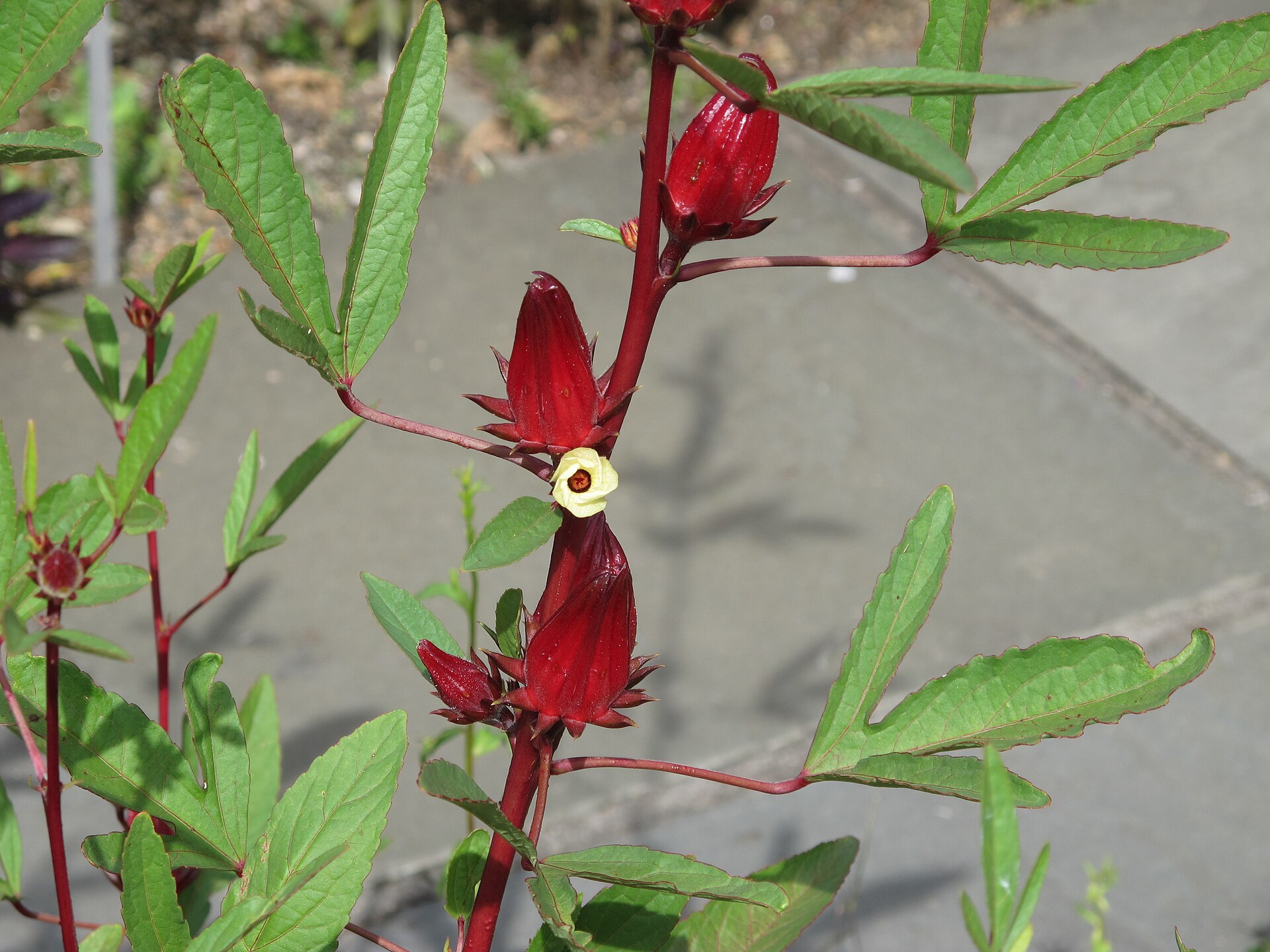
Roselle is a tropical relative of okra, native to Central and West Africa and now grown in many warm regions [1][2]. It grows as an annual and can reach about 7 feet tall [2]. The part used for tea is not the petals but the calyx: the fleshy, bright red, cup-like structure that encloses the seed pod after the flower falls [2]. Jamaica and Mexico are major producers [1].
Hibiscus is best known as a tart red tea and drink [1]. Its most-studied use is blood pressure. Several small trials found that hibiscus lowered blood pressure, but they had design weaknesses. A Cochrane review found the evidence too limited to say whether it works for people with high blood pressure [4][5]. Drugs.com says clinical trial data are lacking to recommend hibiscus for any condition [1].
Hibiscus is generally well tolerated [1]. The main safety issue is interactions with medicines[1][6].
Quick facts
Specimen · Malvaceae
Botanical name
Hibiscus sabdariffa L.
Family
Malvaceae (mallow family)
Other names
roselle, Jamaica sorrel, red sorrel, sour tea, karkade, rosa de Jamaica, Florida cranberry
❦
Names
Common names: hibiscus, roselle, Jamaica sorrel, red sorrel, sour tea, red tea, karkade, rosa de Jamaica, zobo drink [1]; also Florida cranberry, Indian sorrel, and jelly okra [2][3].
Watch the common names: "hibiscus" also means many ornamental garden hibiscus plants. Hibiscus tea comes from H. sabdariffa, specifically its fleshy red calyces [1][2]. See Look-alikes to avoid.
❦
Traditional uses
This section describes how people have used hibiscus historically. It does not show that these uses work. See the next section for the evidence.
Blood pressure: hibiscus has a long history of use in Africa and nearby tropical countries for high blood pressure, liver diseases, constipation, fever, and other conditions [1]. In India, Africa, and Mexico, infusions of the leaves or calyces have been regarded as diuretic and blood-pressure-lowering [3].
Digestion: used in folk medicine as a mild laxative and diuretic [1].
Skin: heated leaves and leaf lotions have been applied to sores, boils, and wounds [3].
Breastfeeding: in some cultures hibiscus is used to increase milk supply. No valid clinical trials support this [7].
Food and drink: the calyces are used for jams, jellies, sauces, and hot and cold drinks, and hibiscus is common in herbal tea blends [1][2]. The leaves can be cooked as greens [2].
❦
What the evidence says
Bottom line: small trials suggest hibiscus may modestly lower blood pressure, but the evidence is not strong enough to rely on. Drugs.com notes that the trials were small and that randomization was often unclear [1].
Use
What was found
Strength
Blood pressure
A 2015 meta-analysis of 5 trials (390 people) found hibiscus lowered systolic blood pressure by about 7.6 mmHg and diastolic by about 3.5 mmHg, with bigger drops in people whose blood pressure started higher [5]. In a 6-week U.S. trial of 65 adults with high-normal or mildly high blood pressure, 3 cups of hibiscus tea a day lowered systolic pressure more than placebo (−7.2 vs −1.3 mmHg) [8].
Weak to moderate; small studies with design problems.
Blood pressure (Cochrane review)
The 2021 Cochrane review, which used stricter criteria, found only 1 eligible trial (60 people) and very low-certainty evidence. It concluded the evidence is insufficient to say whether hibiscus lowers blood pressure in people with hypertension [4].
Insufficient.
Compared with blood-pressure drugs
In a 4-week trial of 193 adults with mild to moderate hypertension, a standardized hibiscus extract lowered blood pressure, but less than the drug lisinopril [9].
One trial.
Cholesterol
A 2020 meta-analysis of 9 trials (503 people with metabolic syndrome and related conditions) found lower total and LDL cholesterol, but no change in triglycerides. The authors called for more high-quality trials [10].
Weak.
What we can't say: hibiscus is not a replacement for blood-pressure medicine or for checking your blood pressure with a health professional. Results from standardized extracts used in trials may not apply to home-brewed tea.
❦
How it’s used / prepared
This is general, traditional information, not a recommendation or a dose for you. Talk with a health professional before using hibiscus for a health purpose.
Parts used: the fleshy red calyces, harvested when tender and plump [1][2].
Tea (infusion): the dried calyces are steeped for hot or iced tea [1]. In the U.S. blood-pressure trial, people drank three 240 ml (8 oz) servings of brewed hibiscus tea a day for 6 weeks [8]. No standard dose has been established [1].
As food: hibiscus is "generally recognized as safe" as a food by the U.S. FDA [7]. The calyces are used for jams, jellies, sauces, and drinks, often as a cranberry substitute [2][3].
Extracts and capsules: trials have used standardized extracts, for example one standardized to 250 mg of anthocyanins (a group of red plant pigments) per dose [1][9]. Products vary.
When to talk to a professional: before using hibiscus regularly if you take blood-pressure medicine, chloroquine, or other regular medication [1][6].
❦
How to identify
Roselle can be grown as a summer annual in warm areas, for example in Florida (zones 9–10), where it is planted in spring and harvested in fall [2].
Plant: an erect, bushy plant up to about 7–8 feet tall, with smooth, typically red stems [2][3].
Leaves: green with reddish veins. Upper leaves are simple, and lower leaves are deeply 3- to 5-lobed (sometimes 7) with toothed edges [3].
Flowers: up to 5 inches wide, single in the leaf axils, yellow or buff with a rose or maroon center. They turn pink as they wither at the end of the day [3].
Calyx (the edible part): after the flower falls, the red calyx enlarges into a fleshy, crisp, juicy cup about 1¼–2¼ inches long, with a collar of 8–12 slim, pointed bracts at the base. It fully encloses a velvety seed pod [3].
Taste: the calyx, stems, and leaves are tart, similar to cranberry [3].
❦
Look-alikes to avoid
When in doubt, don't.
Only make tea from roselle (Hibiscus sabdariffa) calyces from a known plant or a labeled product.
We did not find a source describing a poisonous look-alike for roselle. The issue is that several other Hibiscus plants look similar but don't have the fleshy calyx used for tea.
Red-leaf hibiscus (Hibiscus acetosella)
How to tell: red or bronze, 5-lobed leaves and mauve or red-striped yellow flowers. Its red, ribbed calyx is not fleshy[3].
Why it matters: it has often been confused with roselle. Only its young leaves are used in cooking [3].
Fiber roselle (H. sabdariffa var. altissima) and kenaf (Hibiscus cannabinus)
How to tell: the fiber type of roselle is a tall, sparsely branched plant up to 16 feet, with red or green calyces that are not fleshy, are spiny, and are not used for food. It is sometimes confused with kenaf, another fiber plant [3].
Ornamental hibiscus
Why it matters: many garden hibiscus plants are grown only for their flowers. The term "hibiscus tea" refers to H. sabdariffa[1].
❦
Safety and interactions
Side effects: there is little information about side effects. Hibiscus preparations were well tolerated in clinical trials [1]. No serious side effects were reported in the cholesterol meta-analysis [10].
Allergy: allergic reactions are possible, including cross-reactions with other plants in the mallow family, such as marshmallow and ambrette [7].
Blood-pressure medicines: hibiscus may add to the effect of blood-pressure-lowering medicines and other herbs that lower blood pressure. Drugs.com advises monitoring [1].
Chloroquine: in healthy men, taking chloroquine with karkadi (a Sudanese hibiscus drink) reduced the amount of the drug absorbed into the blood by about 70% compared with water, which could make it less effective against malaria [6].
Other medicines: studies in healthy volunteers found hibiscus changed blood levels of acetaminophen and diclofenac. The clinical effects are unknown [1]. Hibiscus may also raise caffeine levels, lower simvastatin levels, and add to side effects of the cancer drug erlotinib [1].
Digoxin blood tests: hibiscus tea can cause a false-positive result on one type of digoxin test (the electrochemiluminescent immunoassay). Other test methods were not affected [1].
Pregnancy: Drugs.com advises avoiding hibiscus during pregnancy because safety information is lacking [1]. We did not find a source giving a specific reason to avoid it.
Breastfeeding: LactMed says there are no data on whether hibiscus passes into breast milk or on its safety in nursing mothers or infants [7]. Drugs.com advises avoiding it because information is lacking [1].
Children: we did not find child-specific safety information.
Pets: we did not find a pet-safety source for Hibiscus sabdariffa specifically.
Not medical advice
This page is for general education only. It is not medical advice and doesn't replace a doctor, pharmacist, or other qualified professional. Herbs can cause allergic reactions and interact with medicines. Check with a health professional before using any herb, especially if you are pregnant or breastfeeding, giving it to a child, taking medication, or managing a health condition. Never eat or use a wild plant unless an expert has confirmed what it is. For a suspected poisoning in the U.S., call Poison Help at 1-800-222-1222 [11]. In Canada, call 1-844-POISON-X (1-844-764-7669), or the Centre antipoison du Québec at 1-800-463-5060 if you are in Québec [12].
Morton J. Roselle. In: Fruits of Warm Climates. Miami, FL: Julia F. Morton; 1987:281–286. Hosted by Purdue University Center for New Crops & Plant Products. https://hort.purdue.edu/newcrop/morton/roselle.html
Pattanittum P, Ngamjarus C, Buttramee F, Somboonporn C. Roselle for hypertension in adults. Cochrane Database Syst Rev. 2021. https://pubmed.ncbi.nlm.nih.gov/34837382/
Serban C, Sahebkar A, Ursoniu S, Andrica F, Banach M. Effect of sour tea (Hibiscus sabdariffa L.) on arterial hypertension: a systematic review and meta-analysis of randomized controlled trials. J Hypertens. 2015. https://pubmed.ncbi.nlm.nih.gov/25875025/
Mahmoud BM, Ali HM, Homeida MM, Bennett JL. Significant reduction in chloroquine bioavailability following coadministration with the Sudanese beverages Aradaib, Karkadi and Lemon. J Antimicrob Chemother. 1994. https://pubmed.ncbi.nlm.nih.gov/8089046/
McKay DL, Chen CY, Saltzman E, Blumberg JB. Hibiscus sabdariffa L. tea (tisane) lowers blood pressure in prehypertensive and mildly hypertensive adults. J Nutr. 2010. https://pubmed.ncbi.nlm.nih.gov/20018807/
Herrera-Arellano A, Miranda-Sánchez J, Avila-Castro P, et al. Clinical effects produced by a standardized herbal medicinal product of Hibiscus sabdariffa on patients with hypertension: a randomized, double-blind, lisinopril-controlled clinical trial. Planta Med. 2007. https://pubmed.ncbi.nlm.nih.gov/17315307/
Zhang B, Yue R, Wang Y, et al. Effect of Hibiscus sabdariffa (Roselle) supplementation in regulating blood lipids among patients with metabolic syndrome and related disorders: a systematic review and meta-analysis. Phytother Res. 2020. https://pubmed.ncbi.nlm.nih.gov/31833112/