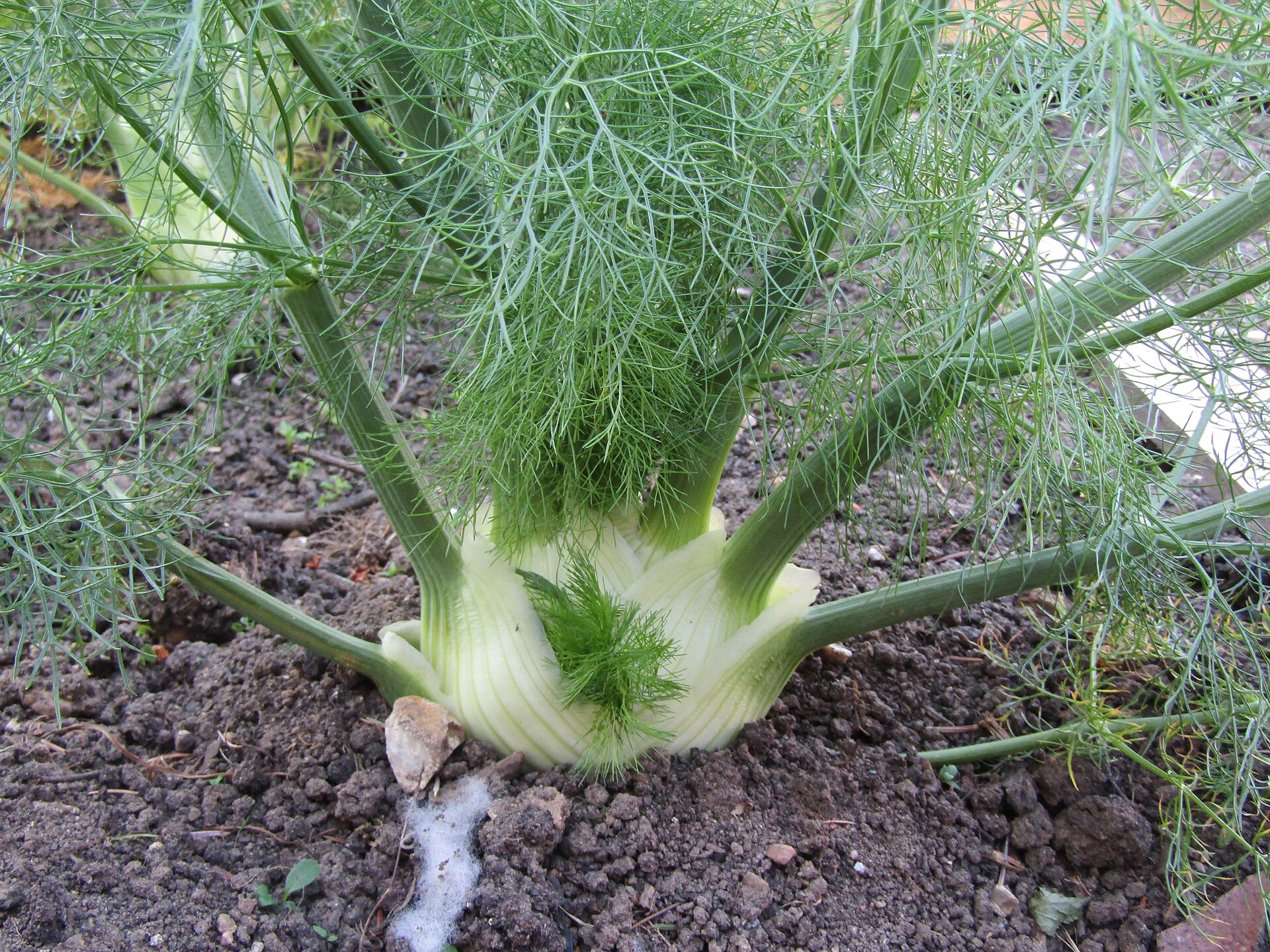
Fennel is a tall, feathery herb with tiny yellow flowers. Its leaves, flowers, and seeds have a sweet, mild anise or licorice flavor [3]. It's native to southern Europe and Asia Minor and is cultivated in the United States [1], where it has escaped gardens and naturalized [3]. The seeds (botanically, the fruits) are the part most used as a remedy [4].
Fennel is a familiar food, but evidence for its medicinal uses is limited[1]. The biggest danger is mistaking poison hemlock for wild fennel[1][5].
Quick facts
Specimen · Apiaceae
Botanical name
Foeniculum vulgare Mill.
Family
Apiaceae (carrot family)
Other names
fennel, common fennel, sweet fennel, bitter fennel, Florence fennel, finocchio
❦
Names
Common names: fennel, common fennel, sweet fennel, bitter fennel, Florence fennel, finocchio, garden fennel, wild fennel [1].
Family: Apiaceae, the carrot family [1]. This is the same family as poison hemlock [2].
❦
Traditional uses
This section describes how people have used fennel historically. It does not show that these uses work. See the next section for the evidence.
Digestion: fennel has been used as an herbal remedy for stomach and intestinal conditions [1]. EU regulators accept it as a traditional remedy for mild, cramping stomach and intestinal complaints, including bloating and gas [4].
Menstrual cramps and coughs: EU regulators also accept it as a traditional remedy for minor cramps during periods, and as an expectorant (to help loosen mucus) in coughs with colds [4].
Milk supply and menstruation: as an herbal medicine, fennel is reputed to increase milk, promote menstruation, ease childbirth, and increase libido [1]. It's one of the herbs most commonly used by midwives to try to increase milk supply, according to state surveys [1].
History: fennel was known in ancient China, India, Egypt, and Greece. The Roman scholar Pliny recommended it for improving eyesight. The plant was introduced to North America by Spanish priests [1].
Food and other uses: a flavoring, a scent, and an insect repellent [1].
❦
What the evidence says
Bottom line: limited. Clinical evidence to support fennel for any use is limited [1].
Use
What was found
Strength
Infant colic
In one trial of 125 infants aged 2 to 12 weeks, a fennel seed oil emulsion ended colic in 65% of babies, compared with 24% on placebo. No side effects were reported during the trial [7].
Limited (a single trial)
Menstrual cramps
A Cochrane review found no consistent evidence that fennel worked better than placebo (1 trial, 43 women), and no evidence of a difference from NSAID pain relievers (1 trial, 59 women). The evidence was low or very low quality [8].
Weak
Increasing milk supply
Two small studies found increases in some measures, such as milk volume and infant weight gain, but no increase in the milk-making hormone prolactin has been found [6].
Very limited
Menopause mood
In a trial of 60 postmenopausal women, 3 months of fennel didn't change anxiety or depression scores [1].
Not supported (one trial)
What we can't say: that fennel treats colic, period pain, low milk supply, or any other condition. We didn't find an NCCIH fact sheet on fennel. Note also that the colic trial used a seed oil product, not tea, and safety concerns about infants are covered below.
❦
How it’s used / prepared
This is general, traditional information, not a recommendation or a dose for you. Talk with a health professional before using fennel for a health purpose.
Parts used: the seeds (botanically, the fruits) [4]. The whole plant is aromatic [1].
Tea (infusion): the EU traditional-use monograph describes 1.5 g of the seeds in 250 ml (about 1 cup) of boiling water, steeped for 15 minutes, up to 3 times a day for adults and adolescents, for no more than 2 weeks [4].
Food: the flowers are used in egg and fish dishes, and the seeds in cakes and breads [3].
Fennel oil: the concentrated oil has caused serious side effects (see Safety). We don't describe its use.
❦
How to identify
Buying fennel seeds or bulbs from a store avoids the dangerous look-alike problem. If you grow it, fennel has these features:
Height: an upright, branching plant 3–6 feet tall [3].
Leaves: feathery, yellow-green, and aromatic, divided into needle-like segments [3].
Flowers: tiny yellow flowers in large, flat-topped umbrella-shaped clusters, from June to August [3].
Smell: sweet, mild anise or licorice [3]. All parts are aromatic [1].
Seeds: oblong, about 6 mm (¼ inch) long, greenish or yellowish brown, with 5 prominent ridges and an anise-like taste [1].
❦
Look-alikes to avoid
When in doubt, don't.
If any feature doesn't match, or you can't check all of them, leave the plant alone.
Fennel belongs to the carrot family, along with carrots, parsnips, and dill, and so does poison hemlock. Plants in this family are hard to tell apart, and many foraging mistakes involve them [2].
Poison hemlock (Conium maculatum): deadly
Drugs.com warns that it can easily be mistaken for fennel, and that a small amount of its juice can cause vomiting, paralysis, and death [1].
In one reported case in northern Italy, a husband and wife were poisoned after gathering hemlock leaves they thought were wild fennel. Both recovered after 3 days of hospital treatment [5].
Flowers: small and white (not yellow), in umbrella-like clusters [10].
Leaves: lacy and fern-like, resembling parsley [2][10].
Stems: smooth and hollow, with red or purple spots[2][10].
Smell: often a bad, musty smell described as like "mouse urine" [2]. The roots, leaves, and stems smell foul when crushed [10].
Caution: at some stages of its life, the spots or the bad smell may not be present [2]. Don't rely on any single feature.
If it's eaten: symptoms progress rapidly. Go to an emergency department right away; don't manage symptoms at home [2].
Dill (Anethum graveolens): edible, but a different herb
NC State Extension lists dill as often confused with fennel [3]. Dill also has yellow flowers, but its feathery leaves are blue-green [11].
❦
Safety and interactions
As food: fennel is generally well tolerated in adults, and fennel oil is "generally recognized as safe" (GRAS) for use in food in the U.S. [6].
Allergy: fennel can cause allergic reactions affecting the skin or breathing [4][6], as well as skin rashes and sun sensitivity [1][6]. Some people react to several carrot-family plants, the "celery-carrot-mugwort-condiment" syndrome [1]. EU regulators say not to use it if you're allergic to fennel, other carrot-family plants (aniseed, caraway, celery, coriander, dill), anethole, or mugwort pollen [4].
Fennel oil: swallowing the volatile oil may cause nausea, vomiting, fluid in the lungs, and seizures. A woman with well-controlled epilepsy had a seizure after taking it [1].
Medicines: one lab study suggested a fennel compound can block a liver enzyme (CYP3A4) that breaks down many medicines, so Drugs.com advises caution [1]. EU regulators found no interactions reported [4].
Estragole: a compound in the oil, estragole, caused tumors in animals [1]. This is why EU regulators limit use in children and don't recommend it in pregnancy or breastfeeding [4].
Pregnancy: Drugs.com advises avoiding fennel as a remedy, citing documented adverse reactions and menstruation-stimulating effects [1]. EU regulators don't recommend it, because safety hasn't been established [4].
Breastfeeding: anethole, a main fennel compound, passes into breast milk [6]. LactMed says the small amounts in milk are probably not harmful at usual doses and that some sources suggest limiting use to 2 weeks. However, heavy use of an herbal tea containing fennel, anise, and other herbs appeared to cause toxicity in 2 breastfed newborns. Mothers should avoid fennel if they or their babies are allergic to carrots, celery, or other carrot-family plants [6]. Drugs.com and EU regulators advise against it while breastfeeding [1][4].
Infants and children: fennel tea given to infants for long periods was followed by early breast development in 4 girls, with high estrogen levels. It went away 3 to 6 months after the tea was stopped [1]. EU regulators don't recommend fennel remedies under age 4 because of a lack of data, and limit use in children aged 4 to 12 based on estragole content [4].
Not medical advice
This page is for general education only. It is not medical advice and doesn't replace a doctor, pharmacist, or other qualified professional. Herbs can cause allergic reactions and interact with medicines. Check with a health professional before using any herb, especially if you are pregnant or breastfeeding, giving it to a child, taking medication, or managing a health condition. Never eat or use a wild plant unless an expert has confirmed what it is. For a suspected poisoning in the U.S., call Poison Help at 1-800-222-1222 [9]. In Canada, call 1-844-POISON-X (1-844-764-7669), or the Centre antipoison du Québec at 1-800-463-5060 if you are in Québec [12].
Alexandrovich I, Rakovitskaya O, Kolmo E, et al. The effect of fennel (Foeniculum vulgare) seed oil emulsion in infantile colic: a randomized, placebo-controlled study. Altern Ther Health Med. 2003. https://pubmed.ncbi.nlm.nih.gov/12868253/